

New Report Finds People With Disabilities, People Without Savings and Older People Bear Greater Harm From Online Scams
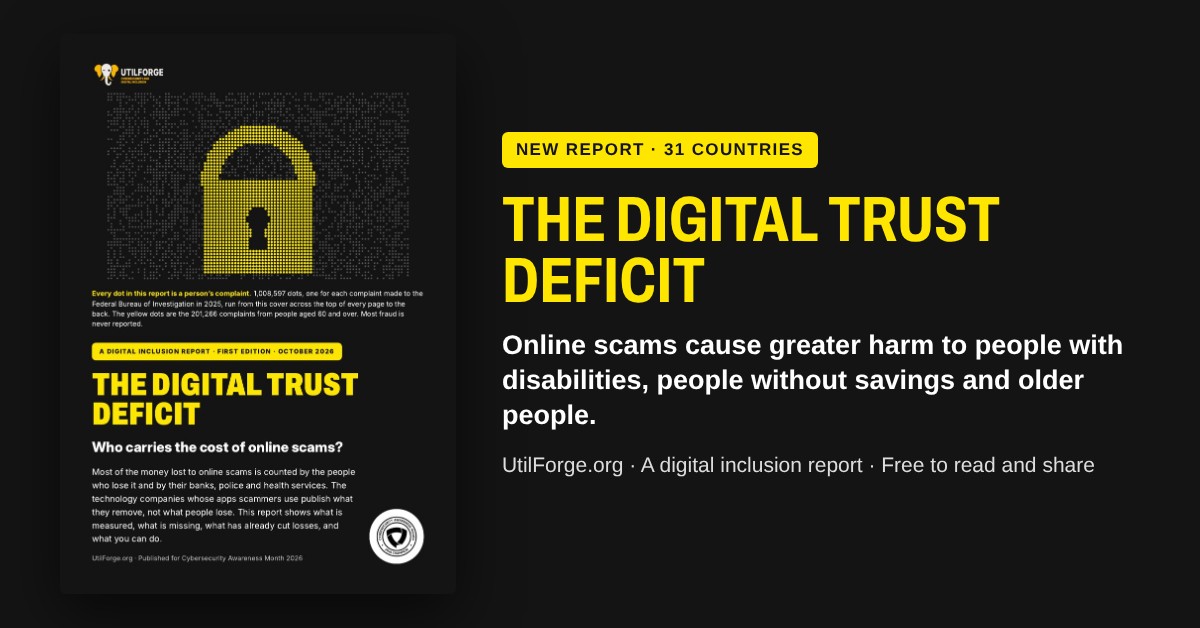
The Digital Trust Deficit: who carries the cost of online scams?, a digital inclusion report from UtilForge.org, finds that online scams cause greater harm to people with disabilities, people without savings and older people.
As part of Cybersecurity Awareness Month, The Digital Trust Deficit Report shows who online threats reach, who is protected and who recovers in 31 countries.
In the United States, 39.2% of bank-fraud victims who could not cover a US$400 emergency did not get all their money back, against 20.0% of victims with three months of savings, according to the Federal Reserve Bank of Kansas City. In a Gallup survey conducted for the Stop Scams Alliance, 58% of scammed households earning less than US$80,000 reported moderate or severe hardship, twice the proportion among higher-earning households.
Older people carry a larger share of the losses. People aged 60 and over made one in five complaints to the Federal Bureau of Investigation in 2025 and reported 37% of the money lost, US$7.7 billion. Across low- and middle-income countries, about 200 million more women than men do not use mobile internet. Women also name safety and security as their top barrier to using it, according to the GSM Association.
People with disabilities experience more fraud in the four countries that publish the figures. In Australia, 18.1% of people with disabilities experienced personal fraud in a year, against 12.9% of people without disability. In New Zealand, 18% of adults with disabilities experienced fraud in 2025, twice the 9% for all adults.
The people most affected are also the least counted. Most fraud agencies do not publish losses by disability, sex, income or language. Of the seven large technology companies reviewed, none publishes the money people lose to scams on its services, the refunds paid to victims or the revenue from adverts later removed as scams. The cost is counted instead by the people who lose the money, and by their banks, police and health services.
In the United States, reported losses to internet crime reached US$20.9 billion in 2025, according to the Federal Bureau of Investigation. In England and Wales, the Home Office estimates the cost of fraud to individuals at £9.2 billion a year.
The report also documents measures that have reduced losses. In the United Kingdom, since banks were required to refund most victims of bank-transfer scams in October 2024, the share of losses refunded by value has risen from 54% to 65%, and 97% of the claims the rule covers have been refunded, according to the Payment Systems Regulator and the independent evaluation it commissioned.
In Taiwan, the investment scam adverts detected each week fell from 77,484 at their 2024 peak to 388 in June 2026, after a law required platforms to check who places adverts.
Institutions in South Africa, Nigeria, Kenya, Ghana, India, Singapore, Hong Kong, Brazil and the European Union appear in the report in their own published words and figures.
"A safer online world should be developed for the people who carry the most harm. This report brings together the published evidence so that more people have access to the information to make informed choices," said Lindsay McDonald, spokesperson for UtilForge.org.
The report proposes twelve changes, each naming the institution responsible for acting. They include audited yearly disclosure by technology platforms of scam losses, refunds and advert revenue; reporting routes in plain language and in other languages; and fraud figures published by age, disability and language. The report opens with the first steps for anyone who has just been scammed, and where to report in each country.
Alongside the report, UtilForge.org makes free checks available to all, running on the user's own device, including Advert Check, for search engine and social media adverts, and Is This the Official Government Site?
Read and download the report: https://utilforge.org/reports/digital-trust-deficit
About UtilForge.org
UtilForge.org is a digital inclusion organisation offering free cybersecurity and online safety tools and guides, and is a registered 2026 Champion of Cybersecurity Awareness Month, a programme of the National Cybersecurity Alliance. The report is published under the Creative Commons Attribution 4.0 International licence.
Lindsay McDonald
UtilForge.org
lindsay@utilforge.org
Visit us on social media:
LinkedIn
YouTube
Use This 5-Step Cybersecurity Checklist for Online Safety
Legal Disclaimer:
EIN Presswire provides this news content "as is" without warranty of any kind. We do not accept any responsibility or liability for the accuracy, content, images, videos, licenses, completeness, legality, or reliability of the information contained in this article. If you have any complaints or copyright issues related to this article, kindly contact the author above.
