

Social Media Influence in the Exam Room: National Survey About Medical Testing Reveals Changing Patient Expectations
U.S.-based patients’ expectations for testing are changing, potentially at the expense of evidence-based medicine. Patients, feeling empowered by social media, want greater control over test ordering decisions, and some even dismiss doctors’ expertise, mirroring growing mistrust in authority.
Tarrytown, New York, Jan. 07, 2026 (GLOBE NEWSWIRE) --
- 93% of patients expect their doctor to order a test upon request
- 17% have requested a lab test they learned about from social media
- 27% have pursued a blood test, independent of a doctor’s recommendation
A national survey of 1,000 U.S.-based patients conducted by YouGov and commissioned by Siemens Healthineers, highlights a shift in patient expectations toward greater control over their diagnostic testing. The results show a pivot away from solely symptom-based, clinically-indicated orders toward on-demand lab testing and a greater appetite for predictive health insights.
Among adults over 18 who have had lab testing done in the past two years, 93% say they expect their doctor to order a lab test upon request.1 More than 1/3 (37%) have requested a lab test based on health-related content they learned through their own research (e.g., family, friends, or the internet), and nearly 1 in 5 patients (17%) have asked for a lab test based on information learned on social media platforms.
As to what type of testing people are interested in, the survey revealed high interest (89%) in lab testing that can predict health risks. Tests have become more accessible through self-prescribed or home testing options, though that type of access varies from state to state.2 How widely these tests are used is now clearer: 27% have pursued blood testing by a trusted lab provider out of curiosity, independent of a doctor’s recommendation. Fewer patients, 22%, have taken a self-test out of curiosity (e.g., genetic/DNA, fertility, testosterone).
Do patients trust what the doctors order?
While 95% trust their provider to order the most appropriate tests, fewer patients (87%) trust their doctor’s guidance if they advise against a requested test. The 13% who disagree underscore an evolving patient-provider dynamic that challenges doctors to carefully navigate patient expectations (i.e., patient satisfaction) while maintaining evidence-based care.
Further impact of the “do-it-yourself healthcare” phenomenon: Of people who have pursued testing out of curiosity (home testing and self-prescribed blood testing), nearly half (49%) are not sharing their results with a healthcare provider.3 Keeping health information private is not limited to test results either; 20% said they would not disclose to their doctor if they took medical advice from social media. Such patients may not even be aware that the supplements, vitamins, and dietary preferences they may think irrelevant or embarrassing to disclose could affect test results or inform how their results should be interpreted.
While a large portion of the surveyed population have taken advantage of self-prescribed or home testing out of curiosity, often paid out-of-pocket, others struggle to afford the basic tests they need to inform their care. Among nearly a third with unpaid medical bills, 52% said their debt included unpaid lab testing fees.
The perceived value of lab testing, however, is high. The data affirm patients trust in vitro diagnostic test results to provide information of value that contributes to their care decisions. Nearly all respondents (98%) say lab results provide meaningful insights into their health and 94% say they’re more likely to follow a doctor’s advice when it’s backed by test results. Patients also say they are more likely to delay other types of care when cost is a factor and they need to pay out of pocket—22% would delay imaging, whereas only 5% would delay bloodwork.
The survey report also explores:
- How accessible is testing in America?
- What motivates patients to pursue testing on their own?
- How does the cost of testing affect patients’ testing decisions and care?
The gap between patient expectations and testing realities
Lab testing reimbursement cuts threaten to widen the gulf between what patients expect and what testing providers may reasonably be able to deliver. Laboratories in the U.S. soon face payment cuts of up to 15 percent for around 800 laboratory tests.4 This is in addition to payment reductions that already have impacted 72% of commonly used laboratory tests under the Protecting Access to Medicare Act (PAMA). Laboratories caution that further cuts will stifle innovation that benefits patient care. The Reforming and Enhancing Sustainable Updates to Laboratory Testing Services (RESULTS) Act is gaining support as a potential option to help stabilize payments for laboratory tests and preserve access to quality laboratory services.5,6
“It’s clear: patients want more control over their health and information about their health earlier,” said Michele Zwickl, head of laboratory solutions, Diagnostics, Siemens Healthineers North America. “Every patient deserves access to high-quality, innovative diagnostic testing. Sustained investment in laboratory services advances personalized care and ensures that the promise of predictive health insights becomes a reality.”
1 Patient Testing in America: Insights and Trends from a National Survey | Siemens Healthineers
2 Policy Statement: Direct Access Testing | American Society for Clinical Pathology
3 Patients Are Diagnosing Themselves with Home Tests, Devices and Chatbots | Wall Street Journal
4 Stoplabcuts.org | American Clinical Laboratory Association
5 Provider Organizations Issue Letter to Congress Urging Passage of PAMA Reform Bill | 360Dx
6 2025 RESULTS Act Provider Letter | American Clinical Laboratory Association
###
Siemens Healthineers pioneers breakthroughs in healthcare. For everyone. Everywhere. Sustainably. The company is a global provider of healthcare equipment, solutions and services, with activities in more than 180 countries and direct representation in more than 70. The group comprises Siemens Healthineers AG, listed as SHL in Frankfurt, Germany, and its subsidiaries. As a leading medical technology company, Siemens Healthineers is committed to improving access to healthcare for underserved communities worldwide and is striving to overcome the most threatening diseases. The company is principally active in the areas of imaging, diagnostics, cancer care and minimally invasive therapies, augmented by digital technology and artificial intelligence. In fiscal 2025, which ended on September 30, 2025, Siemens Healthineers had approximately 74,000 employees worldwide and generated revenue of around €23.4 billion. Further information is available at siemens-healthineers.com.
Contact Info
Kimberly Nissen
kimberly.nissen@siemens-healthineers.com
+1 610-241-2129
Attachments


Infographic: Patient Expectations for Testing are Evolving
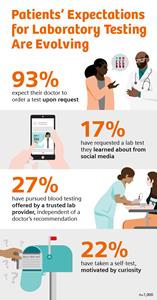
Patients have clear expectations for testing: 93% expect their doctor to order a lab test upon request, with nearly 1 in 5 patients having asked for a lab test based on information learned on social media. Meanwhile, 27% have pursued blood testing by a trusted lab provider out of curiosity, independent of a doctor’s recommendation.
Legal Disclaimer:
EIN Presswire provides this news content "as is" without warranty of any kind. We do not accept any responsibility or liability for the accuracy, content, images, videos, licenses, completeness, legality, or reliability of the information contained in this article. If you have any complaints or copyright issues related to this article, kindly contact the author above.
